I built this page during the week I had three client calls stacked across four time zones and still somehow convinced myself I didn't need blackout curtains. Two years into fixing my own sleep after I fell asleep mid-presentation, I've read more sleep studies than most people read email — and I keep this chart pinned in a browser tab because I got tired of re-Googling the same five numbers every time someone in Slack asked "wait, what temperature should my bedroom actually be." Everything below is pulled straight from the source it's linked to, not from whatever sleep-influencer graphic keeps getting reposted. Skip to whatever section solves tonight's problem — I won't be offended.
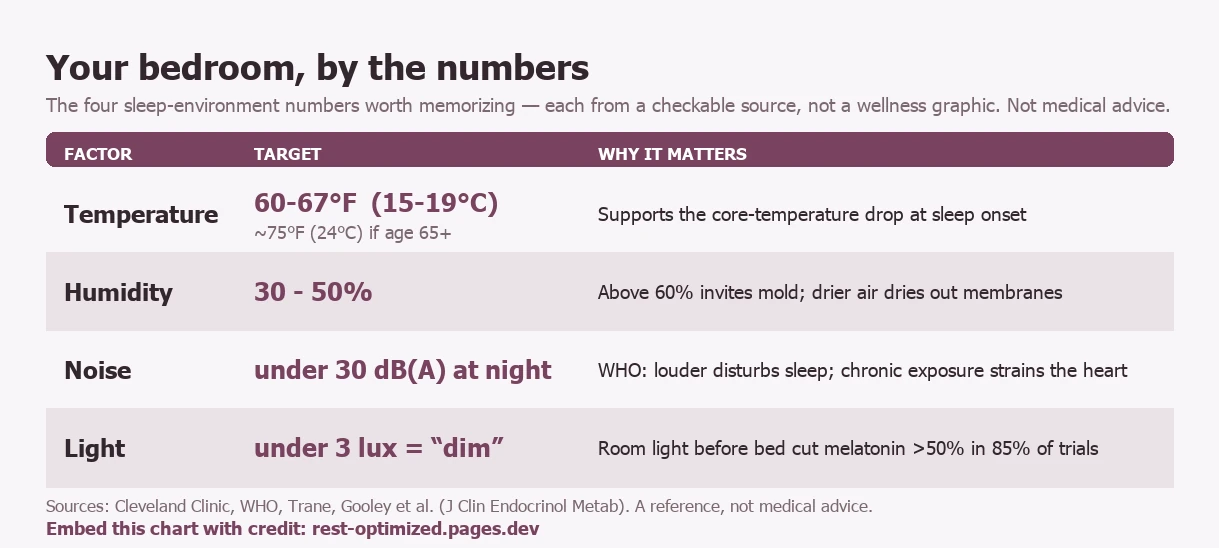
The four numbers worth memorizing: cool (60–67°F / 15–19°C, or about 75°F if you're 65+), dry (30–50% humidity), quiet (under 30 dB at night), and darker than you'd guess — in a Harvard sleep-lab study, ordinary room light before bed suppressed melatonin by more than 50% in 85% of trials. Four numbers, each from a checkable source rather than a reposted graphic.
Environmental Optimization Standards
Look — I used to think "bedroom environment" meant a $40 candle and calling it self-care. Then I actually went and read what sleep researchers measure, and it turns out the room itself is doing more work than any candle ever will. Here's what's backed by a real, checkable source — not a wellness Instagram graphic:
| Variable | Recommended Range / Threshold | Impact on Sleep Quality |
|---|---|---|
| Ambient Temperature | 60–67°F (15–19°C) for adults [Cleveland Clinic]; ~75°F (24°C) for adults 65+ [ScienceDaily] | Cooler temps assist the natural core-temperature drop tied to sleep onset. A 2026 Griffith University study found that holding the bedroom at 24°C — not colder — reduced heightened overnight stress-response markers in adults 65 and older compared with hotter nights. |
| Relative Humidity | 30%–50% [Trane] | Keeps mucous membranes from drying out overnight. Push past 60% and you're promoting mold and mildew growth instead of better sleep. |
| Ambient Noise | <30 dB(A) indoors in bedrooms at night; <40 dB(A) annual average (Lnight) outside bedrooms [WHO] | WHO ties noise above these thresholds to sleep disturbance and, with chronic exposure, cardiovascular effects. |
| Light Intensity | <3 lux counts as "dim light"; <200 lux is ordinary "room light" [Gooley et al., J Clin Endocrinol Metab] | In a Harvard/Brigham sleep-lab study, exposure to ordinary room light before bed suppressed melatonin by more than 50% in 85% of trials and shortened melatonin duration by about 90 minutes. |
For what it's worth — I spent about $200 on a "cooling" mattress pad two summers ago, right before a board deck was due during a heat wave. It leaked, stained the sheets, and I ended up sleeping with a box fan aimed directly at my face instead. Sometimes the free fix beats the gadget.
Sleep Tracking Modalities
Here is the thing about sleep trackers — I've worn four different ones, and the data made me more anxious before it made me calmer. I still use one because it's genuinely useful for catching patterns (like the week those international calls wrecked my sleep score five nights running), but don't let a "readiness score" run your morning stand-up the way I let mine for a while.
| Device Type | Primary Sensors | Reported Accuracy (vs. PSG) |
|---|---|---|
| Smart Rings (e.g., Oura Gen 4) | PPG, Skin Temp, Accelerometer | >95% alignment with polysomnography in 2026 validation data [Ubie]. |
| Wearable Bands (e.g., Whoop) | High-frequency PPG, HRV tracking | Moderate to high agreement for two-stage (sleep/wake) classification; built more around strain and recovery scoring than precise stage-by-stage detail. |
| Smartwatches (e.g., Apple Watch) | PPG, ECG, SpO2 | FDA-cleared sleep apnea notifications, validated in a large-scale clinical study [Apple Newsroom]; good at flagging breathing disturbances, less precise for exact REM/Deep stage splits. |
| Under-Mattress Sensors | Ballistocardiography (BCG) | Non-wearable; systems like the Withings Sleep Analyzer combine pneumatic and ballistocardiography sensors for passive breathing-pattern and disturbance tracking [PMC Review]. |
The ring that didn't work for me was an early smart-ring model that died mid-flight to a conference and gave me exactly zero data for the one week I actually needed it. Lesson learned: charge the thing the night before a trip, not during the layover.
Sleep Architecture and Stages
I used to assume "deep sleep" was the only stage that mattered, like it was the headline slide and everything else was filler. Turns out a full night runs more like a real meeting agenda — every stage gets its own line item, and skipping one throws off the whole thing.
| Stage | Percentage of Total Sleep | Primary Physiological Function |
|---|---|---|
| N1 (Light Sleep) | ~5% | Transition from wakefulness to sleep; easily interrupted. |
| N2 (Light Sleep) | ~45% | Heart rate slows; body temperature drops as sleep spindles and K-complexes appear on EEG — patterns linked to memory consolidation. |
| N3 (Deep/Slow Wave) | ~25% | The body repairs and regrows tissue, builds bone and muscle, and strengthens the immune system [StatPearls / NCBI Bookshelf]. |
| REM (Rapid Eye Movement) | ~25% | Emotional processing and dreaming; the hippocampus and amygdala are especially active, and REM supports memory consolidation. |
Ergonomic Suitability by Sleep Position
Mattress firmness felt like the least important decision I'd ever make until I spent three months on a topper that was wrong for how I actually sleep, and woke up with a stiff lower back before every big presentation for an entire quarter. Firmness is rated on a 1–10 industry scale (1 = softest, 10 = firmest):
| Sleep Position | Recommended Firmness | Ergonomic Rationale |
|---|---|---|
| Side Sleepers | 4–6 (Soft to Medium) | Requires pressure relief for shoulders and hips to maintain spinal alignment [Mattress Clarity]. |
| Back Sleepers | 6–7 (Medium to Medium-Firm) | Requires a balance of contouring for the lower back and support for the spine. |
| Stomach Sleepers | 7–9 (Firm to Very Firm) | Requires maximum support to prevent the hips from sinking and arching the back. |
Common Sleep-Supportive Compounds
I've tried both of these during genuinely brutal stretches — the kind of month where the calendar is back-to-back and my brain won't stop drafting emails at midnight.
- L-Theanine
- The one that actually helped me wind down before a late board call without knocking me out cold. It's an amino acid found in tea leaves that increases alpha brain wave activity and promotes relaxation without direct sedation by modulating glutamate and GABA.
- Tryptophan
- An essential amino acid and precursor to serotonin and melatonin. Dietary or supplemental intake is associated with reduced wakefulness after sleep onset (WASO) — the industry term for the "wide awake at 3am" problem.
A quick disclaimer, because I'm not a doctor and I don't want anyone treating my spreadsheet like a prescription: everything on this page is personal experience and research for informational purposes only, not medical advice — and everyone's sleep needs are genuinely different. If you're dealing with real insomnia, sleep apnea, or you're already on medication, please talk to your actual doctor or pharmacist before changing anything based on this page. One interaction worth flagging specifically: tryptophan and 5-HTP supplements can push serotonin to dangerous levels if you're already taking an SSRI, SNRI, or MAOI antidepressant — that combination is a conversation for your prescriber, not something to decide in the supplement aisle.
Last verified: 2026-07-12
Sources
- Cleveland Clinic: What's the Best Temperature for Sleep? (2026)
- ScienceDaily: This Bedroom Temperature Could Help Older Adults Sleep With Less Stress (2026)
- Trane: Ideal Temperature and Humidity Level for Sleep (2026)
- WHO/Europe: Noise (Fact Sheet)
- Gooley et al.: Exposure to Room Light Before Bedtime Suppresses Melatonin Onset and Shortens Melatonin Duration in Humans. J Clin Endocrinol Metab, 2011
- Ubie Doctor's Note: Oura vs. Competitors — The Most Accurate Sleep Rings of 2026
- Apple Newsroom: Apple Introduces Groundbreaking Health Features (2024)
- A Comprehensive Review of Home Sleep Monitoring Technologies: Smartphone Apps, Smartwatches, and Smart Mattresses. Sensors, 2025
- Physiology, Sleep Stages. StatPearls, NCBI Bookshelf
- Mattress Clarity: Mattress Firmness Guide (2026)