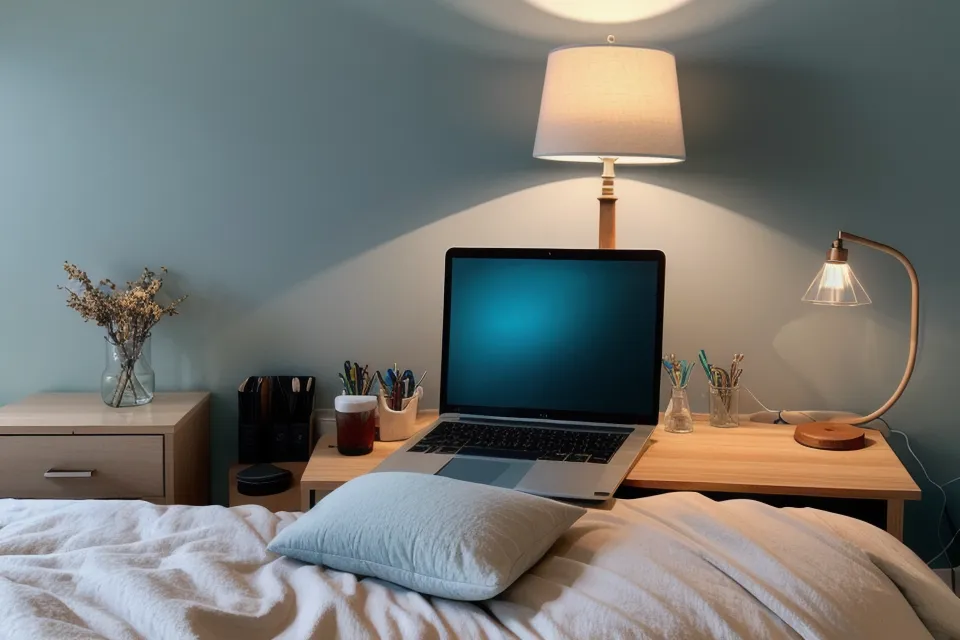
The mess on your nightstand may be doing more for your insomnia than every late-night email you've ever sent. Most advice about fixing your sleep focuses on bedtime rules: screens off after dinner, a fixed wake time, herbal tea on repeat, another app promising to track you into better rest. Nobody mentions the pile of unfolded laundry three feet from your pillow, or the tangle of chargers doing double duty as a nightstand centerpiece. I spent years treating my bedroom like a storage unit that happened to have a bed in it, and no amount of bedtime discipline fixed what the room itself was doing to my nervous system.
Here's the myth: better sleep is a discipline problem you fix by white-knuckling a stricter routine. I tested that as rigorously as I test anything else at work — a strict thirty-day, no-screens-after-9-p.m. rule, blocked into my calendar like a client deliverable. It collapsed by day five, right in the middle of a product launch, when a night of fires meant the laptop stayed open past midnight anyway. The problem was never willpower. My bedroom was still wired to keep my cortisol elevated no matter what time I told myself to put the phone down — stacks of undone tasks in plain sight, in a room that looked like a to-do list with a mattress in it.
The Real Reason Bedtime Rules Keep Failing
Clutter isn't just an eyesore — it's a queue of unfinished tasks your brain won't stop scanning. Every stray mail pile, every half-charged cable, reads as an open loop with a status of "not done yet." I've written before about how to stop thinking about work at night, and the room itself turned out to be part of that problem — no amount of journaling helps if your eyes keep finding new things to flag the second you look up from the page. That's the actual mechanism behind the myth: it was never really about the screen-time rule. It was about how many unresolved items your eyes could find within arm's reach of the pillow.
Bedroom Organization Without a Single New Storage Bin
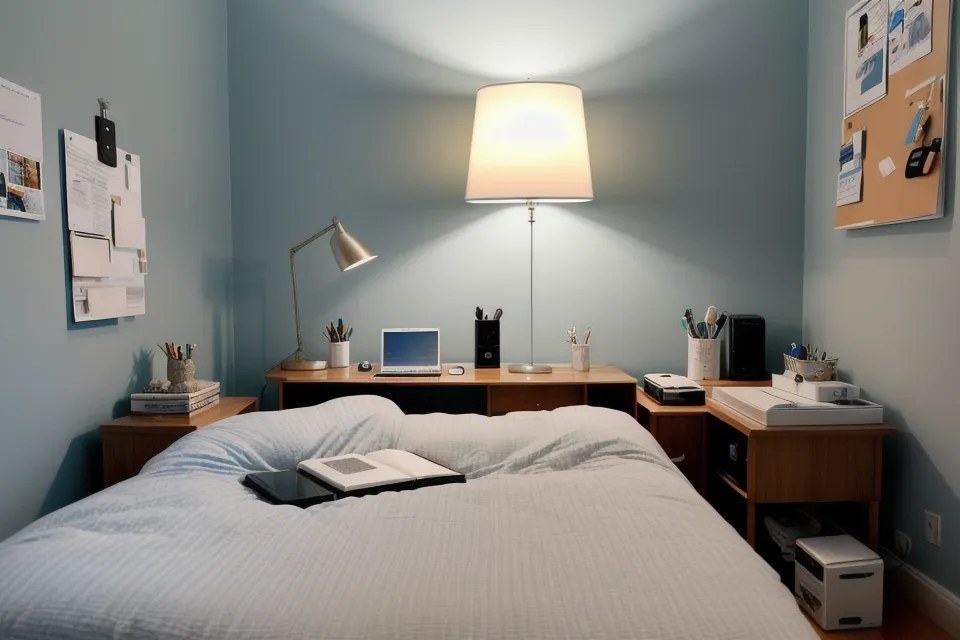
The actual fix took a weekend, not a new set of rules. I moved furniture I hadn't touched in years, dragged the standing desk away from the wall, and found out my nightstand had basically become a satellite office — a folder I swore I'd read on a plane months ago, plus every loose cable in the apartment. My place is in the Inner Richmond, fog rolling in most evenings, and the bedroom there had quietly become the spot where every unfinished task in my life came to rest. I made the classic mistake first: dropped close to two hundred dollars on "aesthetic" storage bins, convinced better containers would fix a containing problem. They didn't. The room just felt smaller, more like a closet than a place to sleep. What actually worked was removing things, not organizing them — the blackout curtains, bought during an entirely different late-night spiral, turned out to matter more than any bin ever could, mostly because they solved a problem instead of hiding one.
A standing desk still holds its corner spot, and the laptop still opens there some nights past ten — old habits die slow deaths in a demanding job. But the mattress pad that keeps the bed at a steady temperature and the water glass with my phone turned face-down on the nightstand do more work than any bin ever did, because they support one function instead of an entire dumping ground of them. A journal sits there too, mostly unread pages, but its presence alone signals something about what that flat surface is actually for.
Does Room Temperature Actually Matter, or Is That Overhyped?
Temperature and air came up constantly once I started paying attention, though I'll leave the deep mechanics of why a cooler room helps to people who've written whole pieces on exactly that. What I can say from direct comparison: a stuffy, too-warm room made every other change feel undone, like decluttering with the windows painted shut. A cheap fix — cracking a window, running a fan, keeping the thermostat a few degrees lower than felt natural at first — did more for how rested I felt than I expected from something so unglamorous. Same with air quality. Wildfire season in the Bay Area makes it obvious fast: a stuffier, smokier room and a cleaner-feeling one produce two completely different nights, regardless of what supplement or app gets thrown at the problem.
Where Supplements Actually Fit Into This
A clean, cool room is the baseline, not the whole plan — I still lean on a supplement most nights, and the environment change is exactly what made my supplement routine worth keeping. YU SLEEP is the one I reach for regularly: natural formula, no melatonin hangover the next morning, and most people who try it notice something early rather than waiting around for results. It's not a replacement for dealing with the actual room, though — that lesson came the hard way, throwing supplements at a problem that was sitting right there in a pile of laundry. On weeks when the schedule turns especially brutal and eating on the run wrecks the usual rhythm, I keep SleepLean around too, mostly for the dual angle of sleep support and a metabolism that isn't running on catering trays and stress.
What Actually Convinced Me the Room Was the Variable
Proof, when it came, arrived in a text I sent to Damien — a friend convinced that enough data will eventually solve anything, insomnia included. At 6:30 one morning, still half-asleep, I screenshotted the Oura app and sent it to him: deep sleep at an hour and forty-two minutes, a number I used to see maybe once a month back when the room still looked like a filing cabinet. He wrote back asking what changed, positive there had to be a formula. There wasn't. Nothing about the supplement routine changed, nothing about a stricter bedtime. Just a room with nothing left in it to argue with my brain about.
Take the Fix on the Road When You Can't Control the Room
Not everyone gets to control their bedroom. Friends in consulting live out of hotel rooms four nights a week and roll their eyes every time I mention my nightstand. They can't move furniture in a Marriott or repaint anything about room 412. What travels is smaller: a familiar pillowcase, a portable air purifier, blackout material that packs flat, anything that recreates a fraction of the same nothing-left-to-argue-with feeling in an unfamiliar space. I've shared my approach to managing the stress that comes with the job with a few of them, and the room-first logic holds even when the room itself is rented for one night. Control what you can carry, and stop treating the rest as a personal failure.
Start With What You Can See From the Bed
So here's the correction, stated plainly: sleep struggles that resist every routine and rule usually aren't a discipline problem — they're an environment problem wearing a discipline costume. Before you download another app or set one more reminder, stand at the foot of your bed and count how many unfinished things are visible from that spot. That number, more than any bedtime rule, predicts how fast your brain actually lets go at night. Clear the surfaces first. A supplement like YU SLEEP can support the process once the room stops working against you, but it won't out-argue a pile of mail sitting in your sightline. And if your insomnia feels like more than an environmental problem, that's a conversation for a professional, not a blog post.
If you're deep in a stretch where nothing about sleep feels fixable yet, recovering from a week of terrible sleep without spiraling further is its own separate skill, worth reading on its own. But most weeks, for most people, the fix is smaller and less glamorous than a new supplement or a stricter rule: clear the room, and let the rest follow.